

You’re reading the free preview.Unlock every conversation for €2.99
FreeFree previewIntroduction

Free to read · the whole Introduction
Introduction
Peter’s first months as a developer, and the evening he meets the Ultra Senior Developer. The complete Introduction of the book, exactly as printed.
The Software Realm, Decoded · A.M. Lorion · pp. 19–21The first meeting
Meet Peter
p. 19Monday morning. Peter’s first day. Coffee in hand. New laptop. Company swag. Excited, a little nervous, and ready to code.
The team lead rattled it off in one breath, impatient and loud, barely looking up:
Pull the latest from main, spin up the Docker containers, and once the services are healthy, we’ll deploy to staging through the Jenkins CI/CD pipeline.
Peter froze for a second. The words landed hard.
To an expert, it was a simple to-do. To Peter, it was overwhelming.
Dumping container orchestration and pipeline management on a junior on Day One wasn’t mentoring, it was setting a trap. The lead didn’t want a new teammate; he wanted to see Peter drown in jargon. This wasn’t a "welcome aboard" moment; it was a "fail fast" test designed to see how quickly Peter would break.
Peter nods. Smiles. Opens his laptop. He has absolutely no idea what any of that means.
Five years in marketing. Twelve weeks in a coding bootcamp. He can build a React app. He knows JavaScript. He landed the job.
But this? This is a different language.
Week two, standup: "Payment service is throwing 500s in prod. Check the Kubernetes logs, might be Redis timeout or Kafka backup."
Peter writes it down. Kubernetes? Redis? Kafka? His bootcamp never mentioned these.
Month one, code review: "Good start, but extract this into a service layer. Also, we need DTOs for the API contract, and consider caching this in Redis to avoid hitting Postgres every time."
Peter’s internal monologue: What’s a service layer? What’s a DTO? Why are there so many databases?
He could write code. That was never the problem.
The problem was the entire world around the code, the containers, the clusters, the pipelines, the monitoring systems, the architectural patterns that everyone assumed he knew.
His bootcamp taught him syntax. His first job expected fluency in an ecosystem no one had explained.
The Gap
p. 20If you’ve been there, you know the feeling.
Maybe you’re a career switcher who learned to code fast but feels lost in professional infrastructure.
Maybe you’re a fresh graduate who aced algorithms but never heard of Kubernetes.
Maybe you’re self-taught, built side projects for years, but production deployments feel like black magic.
Writing code is the easy part. Understanding the ecosystem, that’s what separates juniors from mid-level and senior engineers.
The Legend
p. 20Peter struggled for months. Googling in incognito when no one was watching. Nodding in meetings while panicking inside. Slowly piecing together fragments.
Then he met him.
The Ultra Senior Developer.
You know the type. The one who thinks in hexadecimal binary and dreams in C++. Who can read a stack trace like you read a newspaper. Who can trace a bug from "user clicked button" through React components, REST API, service mesh, Kafka topics, worker processes, and database queries, holding the entire request path in his head like a map.
Peter had heard the legends:
The time the entire production database went down at 3 AM. Everyone panicked. He joined the call, typed three SQL commands, and everything recovered. "Index was fragmented," he said, then went back to sleep.
The time the CEO asked for real-time chat. Everyone said three months. He said, "Give me a week." Delivered in four days. With WebSockets. With fallbacks. With documentation.
Usually, they’re too busy fighting fires to explain things. Too valuable to waste time with juniors.
But this one was different.
The first meetingPeter meets the Ultra Senior Developer
Late one evening, Peter stayed back debugging a mysterious 504 error. Frustrated. Defeated. Every Stack Overflow answer made it worse.
The Ultra Senior walked by, glanced at the screen for three seconds, and said:

The Ultra Senior
Gateway Timeout. Your request is taking longer than 30 seconds. Service mesh is killing it. Not a code bug, infrastructure. Let me show you.
He pulled up a chair. Ten minutes later, Peter understood more than he had in three months.
Not just the fix. The why. Why service meshes exist. Why they have timeouts. Why this timeout killed this request. How to debug it next time.

Peter
Why don’t people just... explain this stuff?
The Ultra Senior smiled.
The Ultra Senior
Because most teams are racing deadlines. They copy working patterns from Stack Overflow. The deeper design reasons get lost. You end up with people who know how to fix bugs, but nobody knows why the system works this way.
He paused.
The Ultra Senior
I was you once. Spent my first year feeling like an imposter Like everyone spoke a language I’d never learned. Nobody explained the big picture. I had to build it piece by piece, the hard way.
He turned to face Peter directly.
The Ultra Senior
I see myself in you. The questions you ask, they’re the right questions. You’re not asking ’how do I fix this?’ You’re asking ’why does this exist?’ That’s how you actually learn.
The Ultra Senior
Ask me anything. I’ll show you how it all connects. Not just what to type, but why the system works this way. The mental models that make everything click.
And he did.
Priceless Conversations
p. 21This book is those conversations!
I was Peter. Career switcher. Self-thaught. Overwhelmed by the professional ecosystem. I spent years building the mental model through trial, error, and late-night debugging.
This book won’t teach you coding, nor is it a summation of each and every framework and/or library (those change constantly). Instead, it gives you the architectural map, the complete mental model of how modern systems actually work.
Three months from now, when someone says "Scale the pods, Kafka’s backed up," you won’t panic. You’ll visualize the data flow. You’ll know exactly what’s happening and where to look.
A year from now, you’ll be explaining the system to the next new hire.
Because here’s the secret: there is no secret language. Just tools and patterns that usually aren’t explained until they break. We’re about to fix that.
The Ultra Senior is ready.
Pull up a chair. Let’s build your mental model.
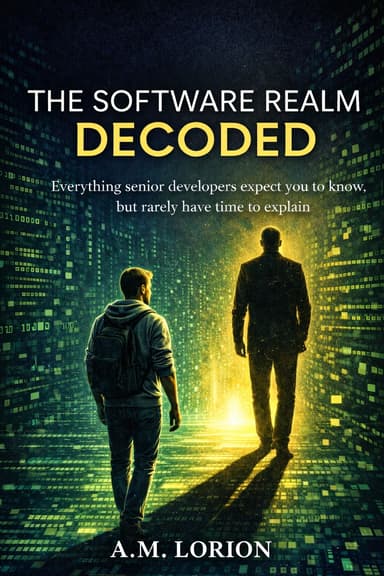
The full book · online access
The conversations you wish you’d had sooner.
Join Peter and a seasoned senior developer as they unpack the tools, terminology and decisions behind everyday software development, one clear conversation at a time.
Ask the questions through Peter. Discover the reasoning with his mentor. Explore the concepts for yourself.
- Follow Peter’s journey through all 12 chapters
- See the explanations come alive in the interactive walkthrough
- Explore concepts through 36 interactive demos
- Pick up where you left off, with progress saved across devices
€2.99incl. VAT · One-time payment, no subscription