

The first EduVerse release
The Software Realm, Decoded
Everything senior developers expect you to know, but rarely have time to explain.
By A.M. Lorion · Published by Softniverse
- Chapters
- 12
- Pages
- 257
- Conversations
- 284
- Technologies
- 144

What They Say vs. What They Mean
Decode the jargon
All 51 boxes from the book, chapter by chapter. Pick a sentence you might hear at work and read what it actually means.
51 sentences
What They Say vs. What They Mean, from The Software Realm, Decoded
Chapter 1 · 1.2.1 What Is the Terminal, Really? · p. 24
What they say
“Open a terminal and run this command.”
What they mean
Open the text-based interface (Terminal on Mac/Linux, PowerShell or Git Bash on Windows) and type exactly what I’m about to show you, then press Enter.
Who is this book for?
If any of these sound familiar, this book was written for you.
- You graduated in computer science but have never deployed to production
- You finished a bootcamp but feel lost in your first professional role
- You’re self-taught and can build projects, but the enterprise ecosystem feels foreign
- You write code but don’t yet understand Docker, Kubernetes, CI/CD or system architecture
- You’re tired of nodding along in meetings while panicking on the inside

Peter & the Senior Developer
Two ways in, both included
Same story, same depth. Read the conversations as a book, or go through them slide by slide.
Online book
Every chapter in your browser: the conversations, figures and code listings exactly as printed, with your place remembered on every device.
Interactive walkthrough
Go through the book slide by slide: the conversations between Peter and the Senior developer, the figures they talk about, and interactive demos to try yourself.
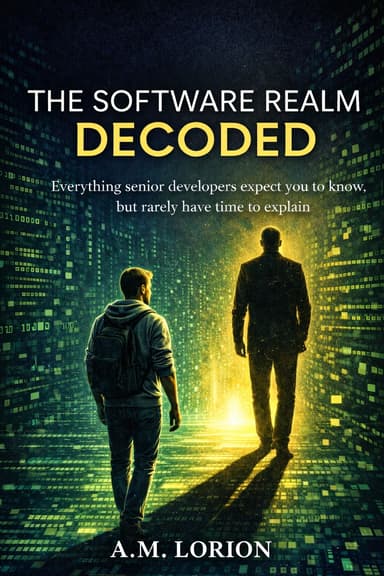
The full book · online access
The conversations you wish you’d had sooner.
Join Peter and a seasoned senior developer as they unpack the tools, terminology and decisions behind everyday software development, one clear conversation at a time.
Ask the questions through Peter. Discover the reasoning with his mentor. Explore the concepts for yourself.
- Follow Peter’s journey through all 12 chapters
- See the explanations come alive in the interactive walkthrough
- Explore concepts through 36 interactive demos
- Pick up where you left off, with progress saved across devices
€2.99incl. VAT · One-time payment, no subscription
Table of contents
Twelve chapters that take you from your first terminal command to production-grade observability. Open a chapter to see what’s inside.
Chapter 1The Foundation Layer


 +6
+6
+6Peter discovers the terminal, learns to navigate with Bash commands and meets Git: branches, commits, pull requests and the environments code travels through.
Starts on p. 23 · 18 conversations
What’s inside
- 1.1Your Daily Command Center
- 1.2The Terminal: Your Gateway to Everything
- 1.3Git and Version Control: Time Travel for Code
- 1.4IDEs: Your Smart Code Editor
- 1.5Local Development Environment: Your Private Playground
- 1.6Peter's Takeaways:
Chapter 2Understanding Code

 +8
+8
+8From classes and objects to RAM and persistence. Peter learns how code comes to life, how OOP works, which languages exist and how package managers hold a project together.
Starts on p. 41 · 19 conversations
What’s inside
- 2.1What You're Actually Building
- 2.2The Languages Ecosystem: Choosing Your Tools
- 2.3Package Managers: The Librarians of Code
- 2.4Peter's Takeaways
Chapter 3Networking - The Invisible Highway+5
+5What Really Happens When You Click
Peter discovers the invisible highway beneath the web: IP addresses, DNS, ports, TCP versus UDP, HTTP/HTTPS, and how processes and threads share the work.
Starts on p. 63 · 28 conversations
What’s inside
- 3.1How Computers Find Each Other: IP Addresses
- 3.2DNS: The Internet's Phone Book
- 3.3Ports: The Apartment Numbers
- 3.4How Data Travels: TCP and UDP
- 3.5HTTP: The Language of the Web
- 3.6Where Data Lives: Memory, Processes, and Threads
- 3.7Putting It All Together: The Complete Journey
- 3.8Peter's Takeaways
Chapter 4Frontend: The User's Window
 +5
+5
+5Where Clicks Become Actions
HTML, CSS and JavaScript are the foundation of every web page. Peter learns to understand the DOM, use DevTools and explores modern frontend frameworks.
Starts on p. 87 · 18 conversations
What’s inside
- 4.1From Bits to Pixels
- 4.2The Core Triad: Structure, Style, and Behavior
- 4.3The Problem: Manual Updates Don't Scale
- 4.4The Browser's Magic: DOM and DevTools
- 4.5Server-Side vs Client-Side Rendering
- 4.6Frameworks: The Three Main Choices
- 4.7Peter's Takeaways
Chapter 5APIs: The Contract +4
+4
+4How Frontend and Backend Agree to Communicate
Peter learns how frontend and backend talk through APIs: REST, parameters, JSON, versioning, authentication (sessions, JWT), CORS and common security risks.
Starts on p. 105 · 41 conversations
What’s inside
- 5.1Peter's First API Problem
- 5.2APIs: The Big Picture
- 5.3Building Peter's First REST API
- 5.4Authentication: Who Are You?
- 5.5The Evolution: From Passwords Every Time to Modern Auth
- 5.6Session Cookies: The Original Solution (Early 2000s)
- 5.7JWT: The Modern Approach (2010s)
- 5.8Sessions vs JWT: The Trade-offs
- 5.9Authorization: What Can You Do?
- 5.10CORS: Peter's Deployment Disaster
- 5.11Security: Defending Against Attacks
- 5.12Peter's Takeaways
Chapter 6Backend Architecture

 +4
+4
+4The Code Behind the Contract
From controller to service to repository: Peter learns how a backend is structured with DI, SOLID principles and DTOs, and when to choose a monolith over microservices.
Starts on p. 131 · 14 conversations
What’s inside
- 6.1Peter's Architecture Journey Begins
- 6.2The Three-Layer Architecture
- 6.3The Dependency Problem
- 6.4SOLID Principles Through Peter's Refactoring
- 6.5The Security Disaster: Entities vs DTOs
- 6.6Monolith vs Microservices: Peter's Growing App
- 6.7Scaling: API Gateway and Beyond
- 6.8Peter's Takeaways
Chapter 7Databases: The Persistent Memory


 +8
+8
+8Where Does the Data Actually Live?
SQL, relations, constraints, transactions, ACID, JOINs, the N+1 problem, indexes, NoSQL alternatives and migrations: everything you need to store data durably.
Starts on p. 149 · 25 conversations
What’s inside
- 7.1Relational Databases: Tables and Relationships
- 7.2SQL Database Landscape: Choosing Your Database
- 7.3Normalization: Avoiding Redundancy
- 7.4NoSQL: Beyond Tables
- 7.5The Rise of Distributed Databases
- 7.6Database Performance
- 7.7Beyond Operational Databases: Analytics and Scale
- 7.8Peter's Takeaways
Chapter 8Beyond Request-Response
 +3
+3
+3When Waiting Becomes the Problem
Asynchronous processing, message brokers, queues, topics, Kafka, RabbitMQ, Redis as a cache, idempotency and dead letter queues: Peter learns that not everything has to be synchronous.
Starts on p. 181 · 22 conversations
What’s inside
- 8.1Synchronous vs. Asynchronous: The Core Difference
- 8.2Message Brokers: When Services Stop Calling Each Other
- 8.3Queues vs. Topics: Two Delivery Patterns
- 8.4Kafka vs. RabbitMQ: Recording vs. Mailbox
- 8.5Redis: The Speed Layer
- 8.6Idempotency: Handling Duplicate Messages
- 8.7Failure Handling: When Things Break
- 8.8Peter's Takeaways
Chapter 9From Code to Production


 +4
+4
+4The build process, artifacts, Docker, container images, registries, Kubernetes, pods, deployments and services: the journey from source code to running application.
Starts on p. 197 · 35 conversations
What’s inside
- 9.1The Old Way: Just Copy Everything
- 9.2From Source Code to Artifact
- 9.3The Environment Problem
- 9.4Containers: Shipping the Environment
- 9.5Docker: Building and Running Containers
- 9.6The Scaling Problem
- 9.7Kubernetes: The Desired State Engine
- 9.8Cloud-Native Mindset
- 9.9The Kubernetes Ecosystem
- 9.10Peter's Takeaways
Chapter 10CI/CD: The Assembly Line

 +4
+4
+4Pipelines, automated testing, deployment strategies, Infrastructure as Code with Terraform, secrets management and GitOps: the assembly line of modern software development.
Starts on p. 215 · 31 conversations
What’s inside
- 10.1The Assembly Line Problem
- 10.2Continuous Integration: No More Integration Hell
- 10.3Continuous Deployment: The Final Mile
- 10.4Infrastructure as Code
- 10.5GitOps: Git as the Source of Truth
- 10.6What You've Been Learning: DevOps
- 10.7Putting It All Together
- 10.8Peter's Takeaways
Chapter 11Observability: The Watchtower


 +5
+5
+5When Production Becomes a Black Box
Logs, metrics and traces: the three pillars of observability. Peter learns the ELK stack, Prometheus, Grafana, OpenTelemetry and the difference between SLI, SLO and SLA.
Starts on p. 235 · 26 conversations
What’s inside
- 11.1The Three Pillars of Observability
- 11.2Logs: The Event Journal
- 11.3Metrics: The Health Dashboard
- 11.4Service Level Objectives: Defining Success
- 11.5Distributed Tracing: Following the Request
- 11.6APM Tools: All-in-One Observability
- 11.7Peter's Takeaways
Chapter 12You Are Now a Mid-Level+ Engineer+6
+6A look back at everything Peter has learned. The big picture comes together: from terminal to production, from code to observability. Reflection, an architecture overview and the road ahead.
Starts on p. 253 · 7 conversations
What’s inside
- 12.1The Transformation
- 12.2Peter's Thank You
- 12.3Recognition
- 12.4Looking Forward
- 12.5The Final Reflection
- 12.6Summer Vacation
Topics and technologies
Every technology covered, explained or compared in the book. Select a logo to learn more.
 C
C C++
C++ C#
C#- CSS
- HTML
- Java
- JavaScript
 Kotlin
- Python
 Rust
Rust Swift
Swift- TypeScript
 Angular
- Node.js
 React
React- Spring
 Vue
Vue- Bash
 Bitbucket
- Git
- GitHub
- GitLab
 Gradle
 IntelliJ IDEA
- Jenkins
- Kubernetes
 Maven
Maven npm
npm VS Code
 Argo CD
- Terraform
 Cassandra
- Elasticsearch
 MariaDB
- MongoDB
- MySQL
- PostgreSQL
- Redis
 SQLite
- Docker
- Linux
 Azure
Azure Google Cloud
- Grafana
 Jaeger
 Kibana
 Logstash
- OpenTelemetry
- Prometheus
- Apache Kafka
- RabbitMQ
 Go
Go- .NET
- Postman
 DBeaver
 Tekton
 Flux
Flux HashiCorp Vault
 Oracle Database
 Microsoft SQL Server
 Snowflake
 Apache Hadoop
- Nginx
- Red Hat OpenShift
 macOS
macOS Windows
 Datadog
 New Relic
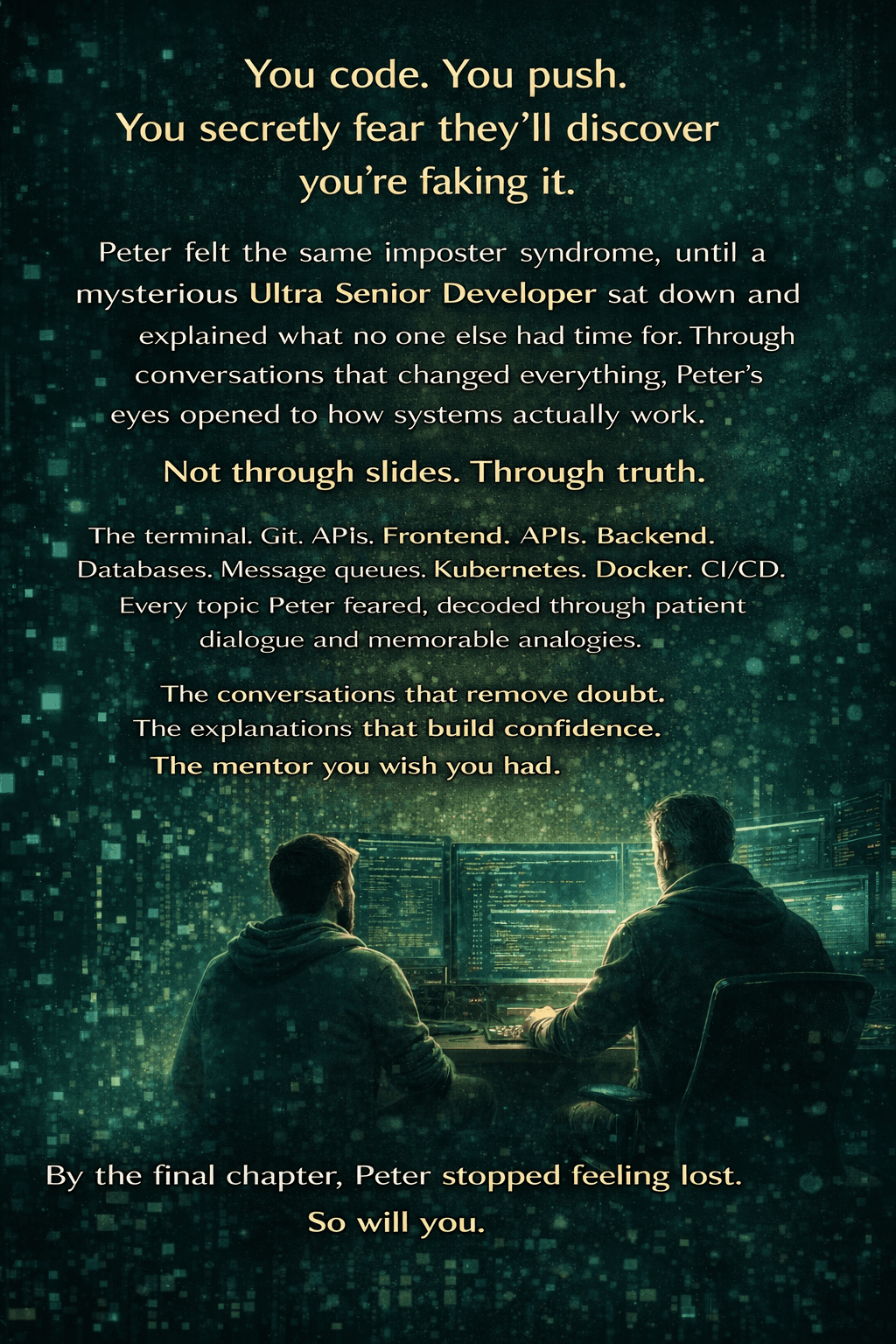
The mentor you wish you had
Peter felt the same impostor syndrome, until a mysterious Ultra Senior Developer sat down and explained what nobody else had time for.
Through conversations that changed everything, Peter’s eyes opened to how systems really work. Not through slides. Through the truth.
By the end of the final chapter, Peter stopped feeling lost. So will you.
Learn with Peter and the Senior Developer
A conversation from chapter 9, quoted verbatim from the book.
Conversation from The Software Realm, Decoded
Chapter 9 · 9.4 Containers: Shipping the Environment · p. 199

Senior developer
Here’s the breakthrough: what if each app could bring its own environment?

Peter
Like... packaging the app with Java 17 and all libraries?
Senior developer
Exactly! That’s a container. Your app + everything it needs to run, packaged together.
Think of a restaurant. The old way:
- Shared kitchen: All chefs use same kitchen (shared server)
- One stove: If someone needs high heat and another needs low heat, conflict!
- Shared ingredients: Someone uses all the salt, others can’t cook
- Mess: Cleanup from one chef affects others
Senior developer
With containers:
- Each chef gets their own mobile kitchen (food trucks for instance)
- Complete setup: stove, ingredients, utensils, everything
- Self-contained: doesn’t interfere with others
- Can park anywhere: any lot (any server)
Peter
So a container is like a food truck for my app?
Senior developer
Perfect! The food truck has everything needed to make your specific dish. It can park at any festival (any server). Multiple trucks can park together without interfering.
Meet Peter. Pull up a chair.
Read the whole Introduction for free, no account needed. When you want more, the full book continues the conversation.
€2.99 for the full book, incl. VAT. One-time payment, no subscription.